
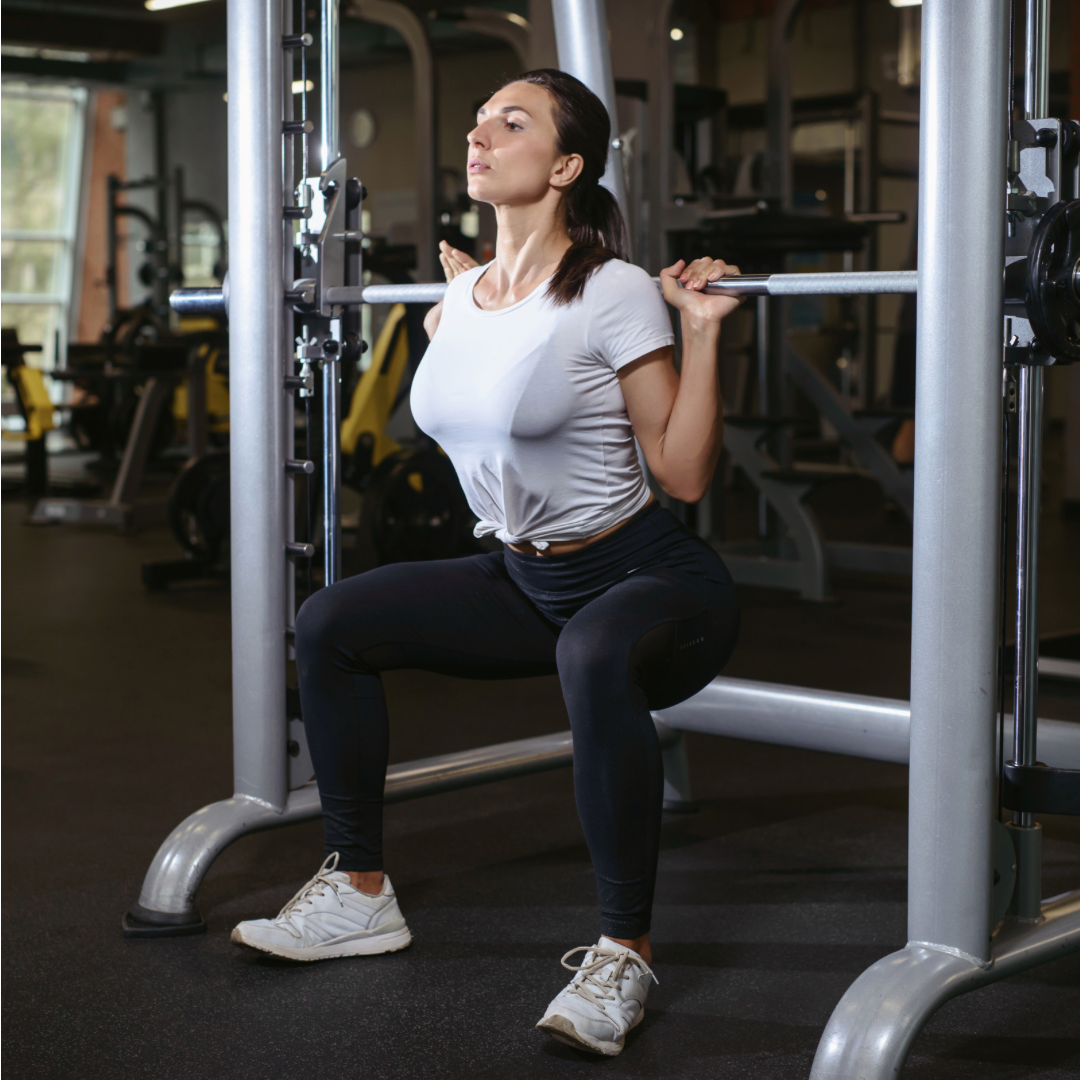
The age-old debate of barbell squats versus Smith machine squats has left fitness enthusiasts divided, each advocating for their preferred exercise.
Both exercises target the lower body and contribute to overall strength and muscle development, but they differ in terms of mechanics, muscle activation, and safety considerations.
In this comprehensive analysis, we delve into the kinesiological aspects of these two squat variations to determine which exercise reigns supreme.
Barbell squats are considered a compound exercise that engages multiple muscle groups. The mechanics of barbell squats demand the recruitment of various muscles, including the quadriceps, hamstrings, glutes, lower back, and core. The free movement of the barbell requires greater stability and balance, activating stabilizer muscles throughout the body. The natural bar path forces the lifter to maintain proper form, leading to functional strength development.
The Smith machine squat involves using a guided barbell within a fixed vertical plane. While it may seem to mimic the barbell squat, the Smith machine’s fixed movement restricts the recruitment of stabilizer muscles.
This isolation of movement can lead to muscle imbalances and reduced functional strength gains. The guided bar can also alter the lifter’s natural biomechanics, potentially leading to suboptimal movement patterns.
Barbell squats require the lifter to stabilize the bar and maintain balance throughout the movement. This results in a higher degree of muscle activation, particularly in the stabilizer muscles of the core and lower back.
The need to stabilize the load also engages the glutes and hamstrings more effectively, leading to well-rounded lower body development.
Due to the guided nature of the Smith machine squat, the lifter relies less on stabilizer muscles. Consequently, muscle activation in the core, lower back, and surrounding stabilizers is reduced.
While the quadriceps remain a primary muscle worked, the limited range of motion and decreased stabilizer engagement may hinder overall muscle development.
Performing barbell squats requires good technique and proper form to prevent injury. However, the need to balance the bar strengthens stabilizer muscles and improves joint stability, leading to enhanced overall functional strength.
Learning the correct form is essential, and it’s advisable to start with lighter weights to master the movement.
The Smith machine offers a guided movement that may provide an illusion of safety, as it reduces the need for balancing the bar. However, the fixed bar path can lead to unnatural movement patterns, potentially placing excess stress on joints.
Moreover, the lack of stabilizer engagement might result in weaker core and back muscles, which are crucial for injury prevention in other activities.
Based on kinesiological principles, barbell squats emerge as the superior choice for overall strength and muscle development. The recruitment of stabilizer muscles and the necessity for balance during the movement make barbell squats a more functional exercise. Additionally, the engagement of core muscles and improved joint stability contribute to injury prevention in other activities.
While the Smith machine squat has its merits, particularly for individuals with limited mobility or recovering from injuries, it falls short in providing the comprehensive muscle activation and functional strength gains that barbell squats offer.
The restricted movement pattern and reduced stabilizer engagement hinder its potential benefits.
Incorporating both exercises strategically can also be beneficial. For example, beginners or individuals with physical limitations can use the Smith machine as a transitional step to develop strength and confidence before progressing to barbell squats.
However, it’s crucial to prioritize proper form, regardless of the chosen exercise, to maximize benefits and minimize the risk of injury.
In the eternal debate of barbell squats versus Smith machine squats, kinesiological insights provide a clear direction. The functional strength, muscle activation, and injury prevention benefits associated with barbell squats make them a superior choice for most individuals seeking comprehensive lower body development. While the Smith machine has its place, it should be approached with caution, and its limitations should be recognized. Remember, the key to success lies not only in the chosen exercise but in the commitment to proper form and consistent training.